

Credit spreads combine a short option with a farther-out long option in the same option class and expiration. The position receives a net credit at entry, while the long option limits the spread’s maximum loss at expiration. For SPX and 0DTE options, that defined boundary does not make the trade low-risk: size, timing, execution, and the path of the index still matter.
Observe the SPX trading room live
This guide explains the mechanics and the questions to ask before evaluating a credit spread. It is educational material, not individualized investment advice or a recommendation to trade. Options trading involves substantial risk of loss and may not suit every person. Past performance does not guarantee future results.
What is a credit spread?
A credit spread exchanges an upfront option premium for limited, measurable risk. SPXGODFATHER frames credit spreads as an options structure to study, not a promise of income or a ready-made trade. A trader sells one option and buys another with the same expiration; the premium received exceeds the premium paid, creating a net credit and a defined expiration payoff.
In a vertical credit spread, both options have the same underlying and expiration but different strike prices. The short option brings in premium. The long option costs premium and creates a boundary beyond which the spread’s loss cannot grow at expiration, assuming the position is held as described and both legs are treated as a defined-risk combination. The opening credit is the most the position can earn before fees and execution effects.
“Credit” describes the cash flow at entry, not the quality or safety of the trade. The position can lose more than the credit received. A spread that appears to have a high probability of expiring out of the money may still carry a loss large enough to outweigh multiple small gains. The risk is determined by the distance between strikes and the net credit, not by the label attached to the strategy.
Credit spread can also mean a difference between borrowing yields in fixed-income markets. That is not the same as an options vertical spread. For example, an NBER paper on option-based credit spreads discusses a credit-spread puzzle and a possible premium associated with tail risk in securities. Here, the focus is the options position built from a short and long option.
How does an SPX credit spread work?
Two option legs determine the credit, the payoff range, and the expiration risk. SPXGODFATHER’s educational approach to SPX options centers on understanding those mechanics before considering a position. One leg is sold and one is bought at another strike, with the same expiration; their premiums combine into a net credit, while their strike gap sets the gross risk boundary.
For a put credit spread, the short put has a higher strike than the long put. The structure is commonly described as bullish or neutral, but that label does not establish what the market will do. For a call credit spread, the short call has a lower strike than the long call. It is commonly described as bearish or neutral. Both structures have a limited maximum gain and a larger possible loss than the received credit when the spread width exceeds the credit.
Consider a purely illustrative spread with a 10-point distance between strikes and a 2-point net credit. The maximum gross gain is 2 points per spread, before commissions and other costs. The maximum gross loss at expiration is 8 points per spread: the 10-point width less the 2-point credit. Actual dollar exposure depends on the contract multiplier, position size, fees, and execution. This arithmetic example is not a suggested SPX trade.
At expiration, a spread can finish entirely out of the money, entirely in the money, or between its two strikes. In the first case, the buyer of the spread may keep the net credit, subject to costs. In the second, the loss reaches the defined maximum. Between the strikes, the outcome changes with the underlying’s settlement level. Before expiration, the spread’s market value can move with the underlying, implied volatility, time, and bid-ask prices, so the expiration diagram does not show every possible path or exit price.
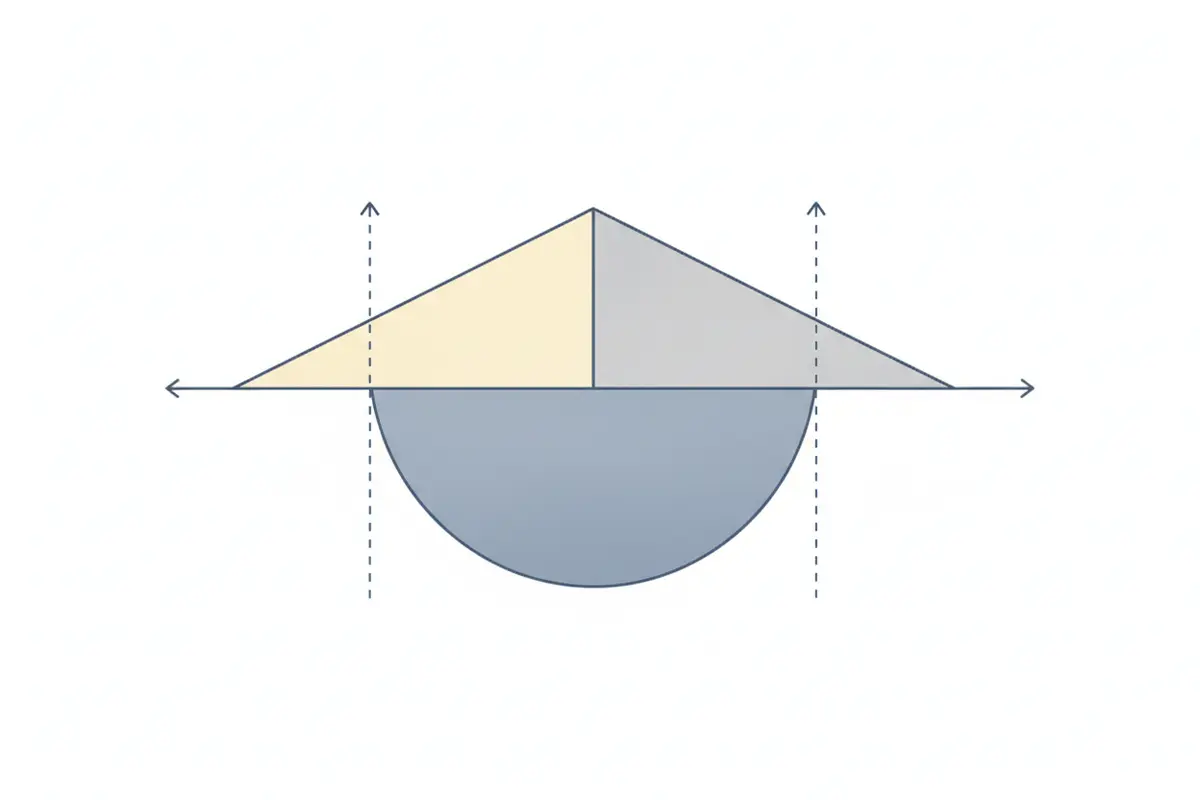
What are the maximum gain and maximum loss?
Maximum gain is the opening credit; maximum expiration loss is spread width minus that credit. SPXGODFATHER emphasizes identifying both figures before evaluating a structure, because the credit alone hides how much capital is exposed. Multiply per-contract results by the number of spreads, then account for costs and the possibility that an exit before expiration differs from the expiration payoff.
For a standard vertical spread, calculate:
- Net credit: premium collected for the short option minus premium paid for the long option, expressed per share or index point according to the contract convention.
- Maximum gain: net credit multiplied by the contract multiplier and number of spreads, before commissions and fees.
- Maximum loss at expiration: strike width minus net credit, multiplied by the contract multiplier and number of spreads, before fees.
- Breakeven: for a put credit spread, short put strike minus credit; for a call credit spread, short call strike plus credit. These simplified formulas describe expiration payoff, not a guaranteed exit price.
Suppose the same illustrative 10-point-wide spread receives a 2-point credit. At expiration, a 1-point adverse move beyond the short strike can create a loss that is already a meaningful fraction of the maximum gain. A move across the full spread width produces the maximum loss. The favorable and unfavorable outcomes are not symmetrical: the possible loss is 8 points while the maximum gain is 2 points, before costs.
This makes position size central. A defined maximum loss is not automatically an acceptable loss. A trader should ask whether the maximum exposure fits a pre-established risk limit and what happens if several positions face similar market conditions at once. For a broader framework on comparing potential gain and loss, see this guide to the risk-reward ratio in options trading.
Which credit spread types should traders distinguish?
Put and call credit spreads differ in strike arrangement, but both exchange limited reward for meaningful risk. SPXGODFATHER’s educational material focuses on the structure and reasoning behind trades rather than presenting a directional label as a forecast. The right comparison is how each position behaves across prices, volatility, and time, including the loss scenario a trader is willing and able to manage.
| Feature | Put credit spread | Call credit spread |
|---|---|---|
| Short option and long option | Sell a higher-strike put; buy a lower-strike put | Sell a lower-strike call; buy a higher-strike call |
| Common directional description | Bullish to neutral | Bearish to neutral |
| Maximum gain | Net credit received, before costs | Net credit received, before costs |
| Maximum expiration loss | Strike width minus net credit, before costs | Strike width minus net credit, before costs |
| Key expiration reference | Short put strike and lower long put strike | Short call strike and higher long call strike |
A credit iron condor combines a put credit spread and a call credit spread at separate strikes. It may collect credit from both sides, but it also introduces risk zones on both sides of the underlying. It is not simply “two credits” or a neutral guarantee. A sharp move, changing volatility, and liquidity in either spread can complicate management. The combined position’s total maximum loss and capital requirement need to be understood as a whole.
A comparison should include more than the premium quoted at entry. Review width, credit as a proportion of width, distance from the underlying, time remaining, the market context, the exit plan, and the loss each structure could produce. Those inputs are not signals by themselves. For background on SPX option mechanics, read this risk-first explanation of 0DTE options and the SPX options trading guide.
How do volatility and time affect a credit spread?
Volatility and time change option prices, but neither reliably tells a trader what the spread will earn. SPXGODFATHER presents live market context as something to observe and learn from, not a substitute for independent judgment. Implied volatility can influence both legs, while the underlying’s movement and remaining time interact with their different strikes and sensitivities.
Higher implied volatility often corresponds with higher option premiums, all else being equal. That can increase the credit available, but it may also reflect greater uncertainty about future price movement. A larger credit is not free compensation: it may come with a wider range of possible outcomes or a higher chance of the short option finishing in the money. The long option’s premium and behavior also change.
Time decay is not a straight line and does not affect both legs identically. As expiration approaches, an option’s value can respond sharply to small underlying moves, especially near a strike. A position can show an unrealized gain or loss before expiration that differs from the terminal payoff calculation. It can also be difficult or costly to close a spread if the quotes are wide or markets move quickly.
0DTE positions add a short clock. There is little time for a thesis to recover from an adverse move, and the value of near-the-money options can change rapidly. A credit spread’s defined terminal risk does not eliminate intraday mark-to-market swings, execution risk, or the need to know what action is intended if price approaches a short strike. A trader should understand the planned holding period and avoid assuming that waiting until expiration is always best.
For a separate explanation of how volatility varies across strikes, review how options structures can respond to volatility and time. That article covers a different structure, but the general lesson applies: each leg has its own price behavior, and a simple directional label cannot describe the whole position.
What risks remain when the loss is defined?
Defined risk describes a payoff boundary, not a low-risk outcome or a simple trade experience. SPXGODFATHER treats risk management as part of options education, including the possibility of losing the full planned amount. Traders must consider price gaps, fast movement, poor fills, contract size, and whether they can monitor a position through the session.
Key risks include:
- Fast market movement: the underlying can move through a short strike quickly, and an intended exit may not fill at the expected price.
- Loss concentration: a spread’s maximum loss can be many times its credit. Multiple positions can expose a portfolio to related market moves at once.
- Liquidity and execution: quoted prices are not a promise of execution. Wide or changing bid-ask spreads can make opening, adjusting, or closing costly.
- Expiration complexity: late-session movement can change the payoff rapidly. Know the product’s settlement conventions and the broker’s procedures rather than assuming every position behaves like a stock option.
- Behavioral risk: traders may increase size after gains, hold losers too long, or change a plan under stress.
- Costs and capital: commissions, fees, margin treatment, and buying power requirements affect the practical outcome and vary by broker and account.
SPX options are cash-settled index options, but traders should verify contract specifications and current broker procedures before trading. Settlement does not remove loss risk or guarantee a convenient exit. Review the terms that apply to the exact contract and account. SPXGODFATHER describes its room as educational mentorship rather than brokerage or personalized investment advice; observation does not transfer responsibility for a participant’s decisions.

How should a trader evaluate credit spreads before entry?
A pre-trade review should make the payoff, conditions, and exit plan explicit before an order is considered. SPXGODFATHER’s live education is intended to show trade reasoning and execution transparently, including the strike and cost announced before a purchase. The viewer still needs a personal process for sizing, risk tolerance, and deciding whether to participate at all.
- Define the position precisely. Record the underlying, expiration, option type, both strikes, spread width, and number of spreads. Confirm that the legs are the intended combination.
- Calculate the payoff. Work out the net credit, maximum gain, maximum expiration loss, and breakeven. Convert those figures into the account’s currency and include estimated costs.
- Check the full risk amount. Ask whether the maximum loss is acceptable, not whether the credit looks attractive. Consider related positions and the possibility that several may lose under the same market conditions.
- Describe the market premise. State what would need to happen for the setup to remain viable and what observation would challenge that premise. A chart pattern or probability estimate is not certainty.
- Review time and volatility. Note time to expiration, implied volatility conditions, scheduled events, and how quickly the position could change. Do not treat elevated premium as proof of a bargain.
- Consider execution. Examine the bid and ask for both legs and think about the net price. Decide how order type, fill quality, commissions, and a possible partial fill affect the intended risk.
- Write down management choices. Before entry, decide what conditions might prompt closing, reducing, or otherwise managing the position. Include the possibility of taking no trade. Avoid inventing a rule in the middle of a fast move.
- Review afterward. Record the planned thesis, actual fills, any decisions, and what was learned. Separate process quality from whether the position happened to make or lose money.
This is a decision framework, not a checklist that makes trading safe. A trader who cannot explain the maximum loss, the exit conditions, or the contract details should pause rather than infer that the structure is suitable. For strike-selection concepts, see the guide to choosing an SPX 0DTE strike; it does not prescribe a strike for an individual.
What can live trade observation teach about spreads?
Observation can show how a trading process unfolds, while leaving every decision and result individual. SPXGODFATHER offers a live Zoom room where trades are presented in real time, including the announced strike and cost before purchase. Watching can help a learner notice how a thesis, order, and risk discussion fit together, but it cannot establish that the same trade suits another account.
Useful observations include whether the reasoning is explained before a position is entered, how an unfavorable move is discussed, and whether losing trades are visible alongside winning trades. Look at the process, not just the final outcome. A single session cannot establish a repeatable edge, and historical examples are not promises of future results.
SPXGODFATHER states that its weekday trading session ends by 11:30 a.m. Eastern Time and that its trading statistics can be reviewed by day, month, and year-to-date for the current year. Statistics and demonstrations should be interpreted with care: they do not predict a participant’s outcome, and performance claims should not be treated as audited or guaranteed. Ask what is shown, what is omitted, and how results are defined.
If you want to understand the education and risk disclosures before observing, read the SPXGODFATHER legal and risk disclosures and the information about Dr. Rolf Haag. The service is educational mentorship, not a registered broker-dealer or investment advisor, and live observation is not a substitute for professional advice tailored to your circumstances.

What should you remember before evaluating credit spreads?
Start with the possible loss and mechanics; treat the credit as only one part of the decision. SPXGODFATHER’s educational perspective is to study both legs, the market context, and the reasoning behind a trade rather than rely on a headline premium. Credit spreads can cap expiration risk, but they can still lose substantially and require informed, independent decisions.
Before evaluating any spread, be able to explain its width, net credit, maximum gain, maximum loss, breakeven, and conditions that could change the position. Consider the time remaining, volatility, liquidity, costs, position size, and exit plan. In 0DTE trading, short time to expiration makes monitoring and execution especially important. There is no spread structure that removes market risk or assures a profit.
Options trading involves substantial risk of loss and is not suitable for all investors. This article is for education only, does not provide individualized investment advice, and does not recommend any specific trade. Examples are hypothetical and exclude costs unless stated. Past performance does not guarantee future results; individual results vary, and no outcome is guaranteed.
See the live room and observe the process
Request a free day pass to observe live
Frequently Asked Questions
Clear answers help reinforce the mechanics without turning an options structure into a promise. SPXGODFATHER presents credit spreads as financial education, and each answer below addresses a general concept rather than an individual account. Verify contract details and consider risk before making any independent decision.
Can a credit spread lose more than the credit received?
Yes. A standard vertical credit spread can lose more than its opening credit. At expiration, its maximum loss is generally the strike width minus the net credit, multiplied by the contract multiplier and position size, before costs. The spread limits the defined expiration payoff; it does not make the position risk-free.
Is a credit spread a good fit for 0DTE options?
There is no universal answer. A 0DTE spread has little time until expiration, and its value can change quickly with the underlying, volatility, and liquidity. Whether a structure fits depends on a person’s knowledge, risk capacity, process, and circumstances. This guide does not make an individualized recommendation.
How do you calculate a credit spread’s breakeven?
For a put credit spread, subtract the net credit from the short put strike. For a call credit spread, add the net credit to the short call strike. These simplified breakevens describe expiration payoff per underlying unit; contract multiplier, costs, and an early exit can affect actual results.
Does a defined-risk spread mean I cannot lose more than expected?
The spread’s payoff at expiration has a defined maximum loss when the legs, size, and contract are correctly understood. However, actual account outcomes can also involve execution, commissions, broker requirements, and position-management decisions. Verify contract terms and broker procedures, and do not treat “defined risk” as a statement that the loss is small or acceptable.
What should I review before observing a live SPX trading room?
Review the educational purpose, risk disclosures, how trades and costs are communicated, and how past statistics are presented. A live demonstration can provide context, but it cannot guarantee future outcomes or determine whether a trade is suitable for you. Participants remain responsible for their own decisions.
What should you take away about credit spreads?
Credit spreads have a defined expiration payoff, but the trade still demands deliberate risk review. SPXGODFATHER encourages learners to focus on mechanics and transparent observation rather than outcomes or promises. Know what each leg does, calculate the full potential loss, and decide independently whether any position and its risks fit your circumstances.
For related reading, continue with the 0DTE risk guide, learn about risk and reward in options, or review the live room observation option. Each resource is educational and does not assure or predict a trading result.
Credit spreads are tools with tradeoffs, and careful preparation cannot remove the risk of loss.
